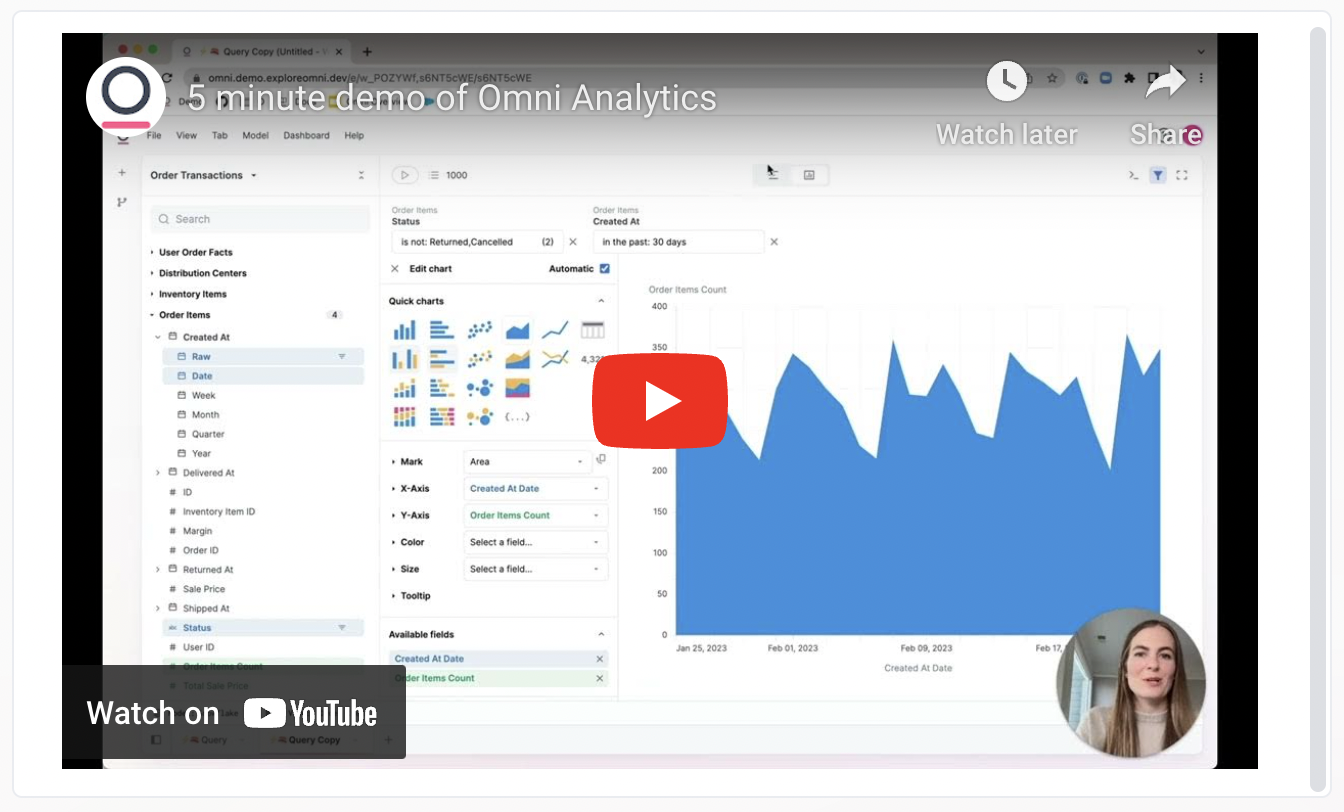

Creating Markdown with AI
You can use the Query Helper to generate markdown visualizations based on natural language prompts. The AI will create rich, flexible data displays that combine HTML, CSS, Mustache template variables, and custom Omni components like<Sparkline> and <ChangeArrow>.
To create a Markdown visualization with AI:
1
Create a query in a workbook.
2
Open the Query Helper.
3
Ask Blobby to create a custom layout (e.g., “Create a custom HTML layout for this data” or “Show this as a formatted text display with sparklines”)
4
Review and refine the generated Markdown visualization as needed.
Using the Markdown editor
When you select Markdown as the visualization type, a Markdown editor will display in the chart’s Options pane. As changes are made, the chart area will automatically update. At the top of the editor is a toolbar to help you generate correct Markdown syntax for common formatting actions.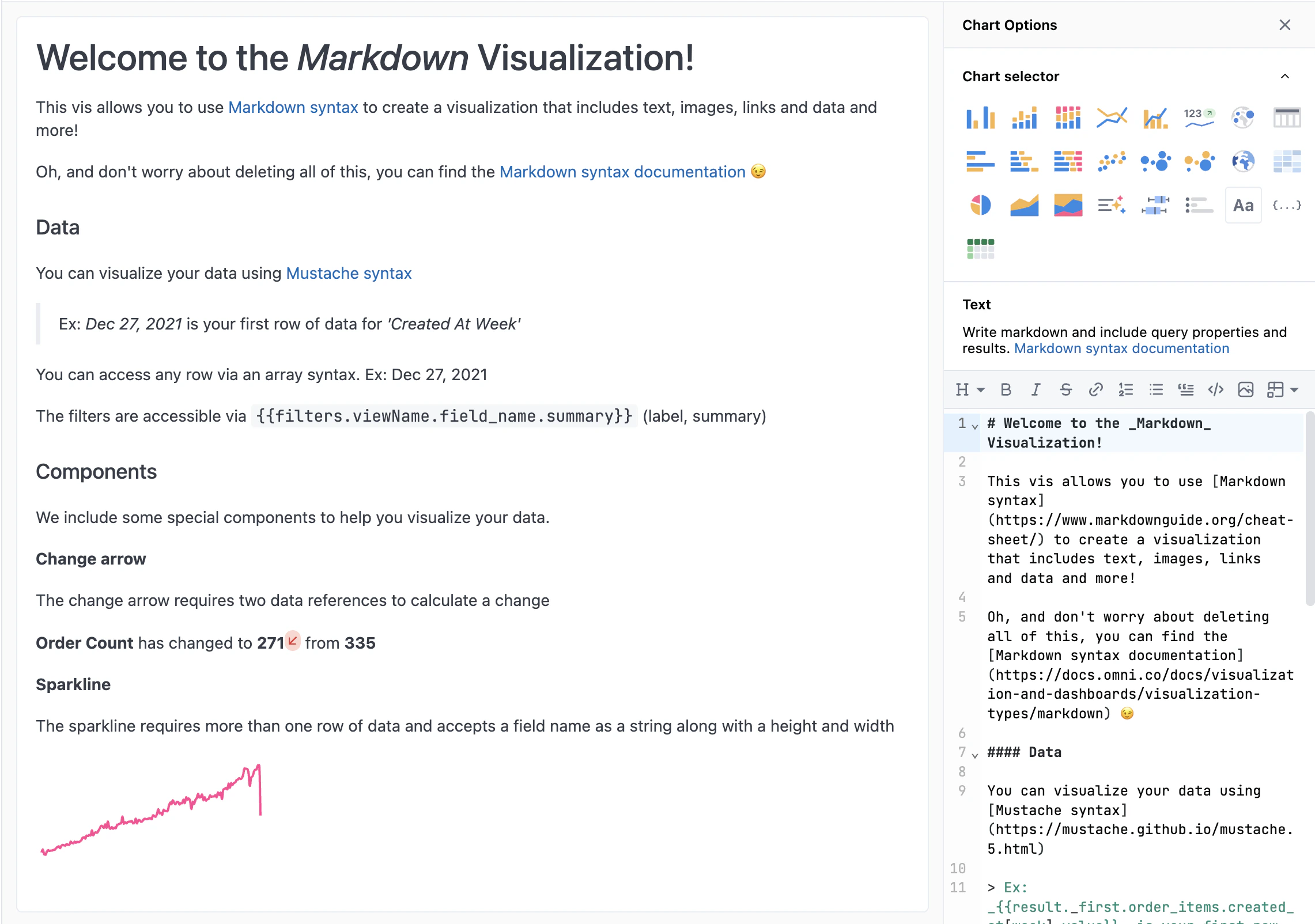
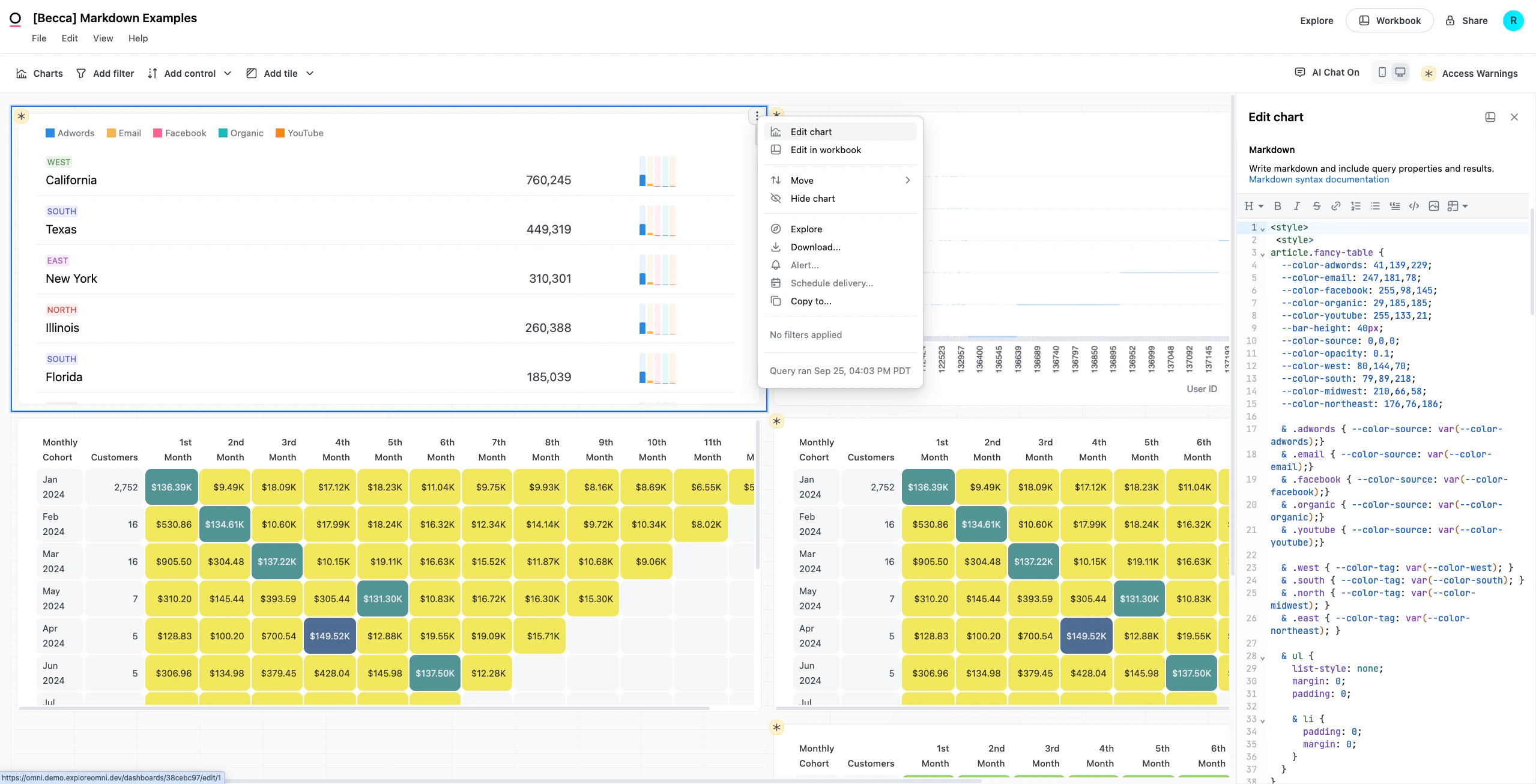
Including HTML
The Markdown editor interprets Markdown first and foremost. While it is possible to incorporate HTML, it helps to think of these more as text documents than true HTML files. When formatting your code, keep the following in mind:- Indentation is interpreted as a code block. Keep your code flush to the left to prevent unintended code blocks.
- Empty lines may cause odd behavior. In Markdown, these are paragraph indicators. This occurs because the
divis included in a code block as plain text, which will strand its closing tag.
Omni sanitizes your HTML and CSS to prevent potential security vulnerabilities. This includes removing JavaScript and interactive elements such as
<form>, <input>, and <script>.When an element is removed for security reasons, a message will appear in the Markdown: “This element is considered dangerous and will not be rendered.”Best practices
While you can use HTML, try to use it sparingly to simplify things. If you do need to use HTML elements:- Use supported semantic HTML elements where possible, such as
articleorsection. Large numbers ofdivsin a row can cause parsing issues. - Limit the depth of
divnesting. Deeply nested elements increase the likelihood of conflicts between the Markdown and HTML parsing. - Use
<style></style>and CSS classes over inlinestyletags for custom CSS.
Limitations
- PDFs in deliveries and downloads may render differently than what’s visible in a browser,, including:
- Directly referencing native HTML tags - for example,
h3 { font-size: 18px; }may not always work - Some characters in CSS can’t be parsed causing those style declarations to be ignored, including:
- The quotation marks needed for
content: "<value>";will not work &.and&:notation in your CSS will be ignored. Do not use this syntax if you nest your CSS.
- The quotation marks needed for
- Directly referencing native HTML tags - for example,
- Invalid HTML or CSS syntax may not render correctly in PNGs or PDFs even if it correctly renders in a browser. For example,
@media
Dark mode styling
When your Omni instance is in dark mode, the Markdown visualization automatically receives aprefers-dark class. You can use this class to apply different styles based on the theme.
To target elements in dark mode, use the &.prefers-dark selector in your CSS:
h1 elements will be red in light mode and blue in dark mode. The custom-element class will have a green background in light mode and yellow in dark mode.
Referencing query elements
Data and other elements from the query can be exposed using Mustache syntax. For example,{{query_element}}. The full list of query elements can be seen using {{ inspect }}.
To reference query elements, you can do any of the following:
1
Use the Query details dropdown menu inside the Markdown editor.
2
Click any cell in the results table to copy the Markdown syntax: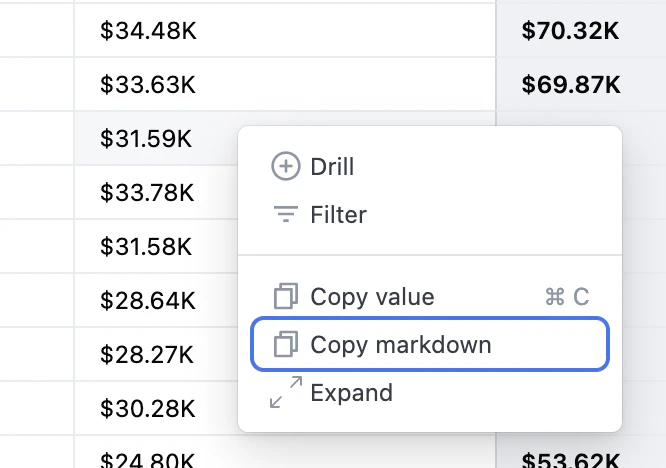
3
Write the syntax directly, for example:
Looping through the results set
To iteratively generate Markdown tiles based on the results set, use{{#result}} and {{/result}} to create a loop. For example:
result._pivots or row._pivots. This allows templates to work dynamically when filters change which pivot values exist. See pivot iteration for full syntax and examples.
Check out these examples to see this pattern in action:
Adding visual components
Along with adding images and code to help highlight your data, you can also use the built-in components to create inline visualizations:- Change arrow - Adds an arrow icon indicating the type of change between two data points
- Sparkline - Adds a sparkline. Useful for seeing the shape in variation in a condensed way.
Change arrow
Adds an arrow icon indicating the type of change between two data points. If the change is a positive number, the arrow will be green. If negative, it will be red. To use this component, your results must include two data points that can be used to calculate a change.
Properties
Sparkline
Adds a sparkline. Useful for seeing the shape in variation in a condensed way. To use this component, your results must have more than one row of data and a field name.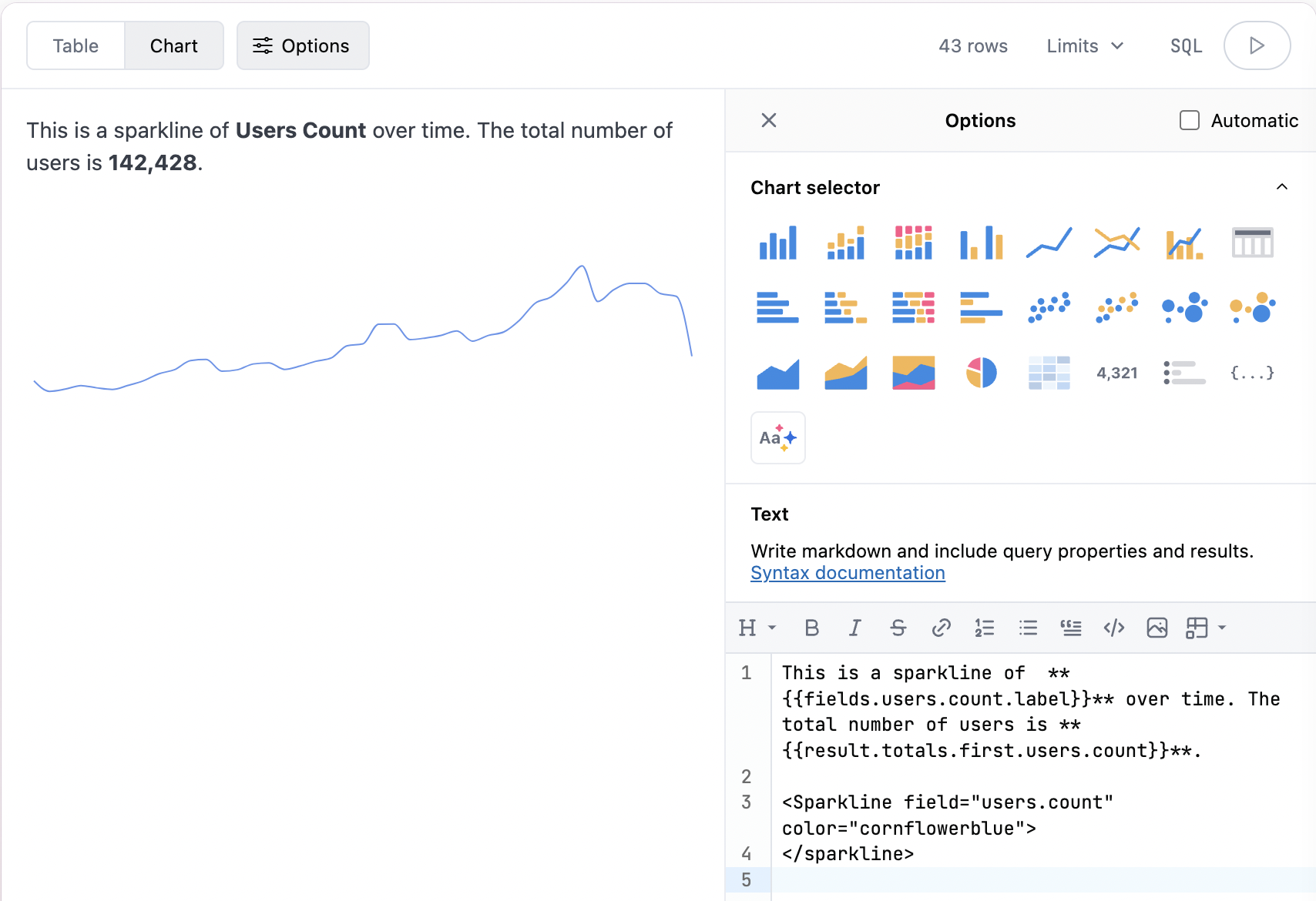
Properties
Adding iframes
Using iframes in a Markdown visualization is also supported. iframes can be parameterized with query elements. By default, Omni applies restrictions (sandboxing) when rendering iframes. This means that some website features, such as popups, may be unavailable or incompatible. Use the dropdowns to check out some examples.Google Docs
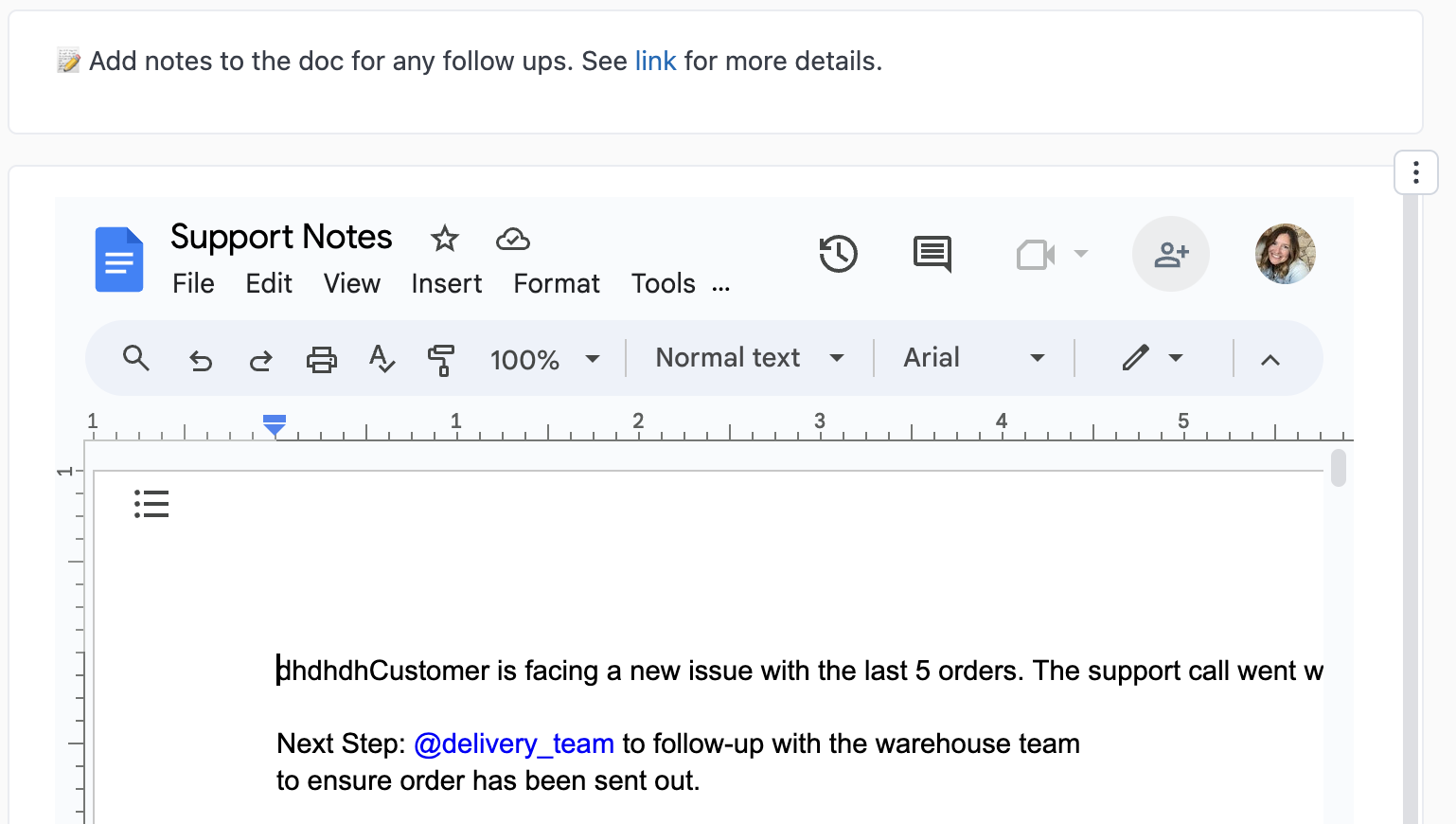
Google Docs
Before embedding in Omni, publish the doc and retrieve its embed link.
Google News
Google News
Code:Result:
Google Maps
Google Maps
Code:Result: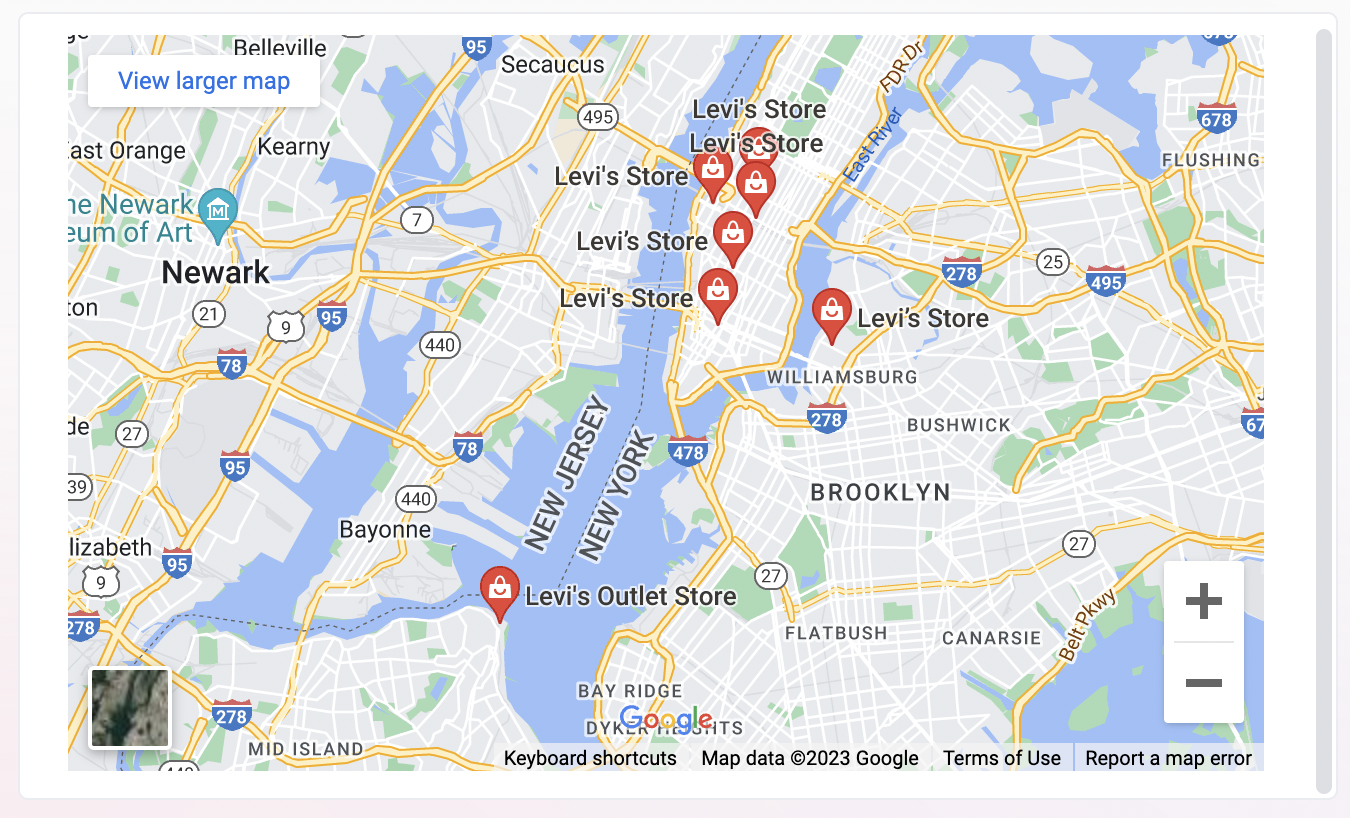
Twitter/X
Twitter/X
Code:Result:
Windy
Windy
Code:Result: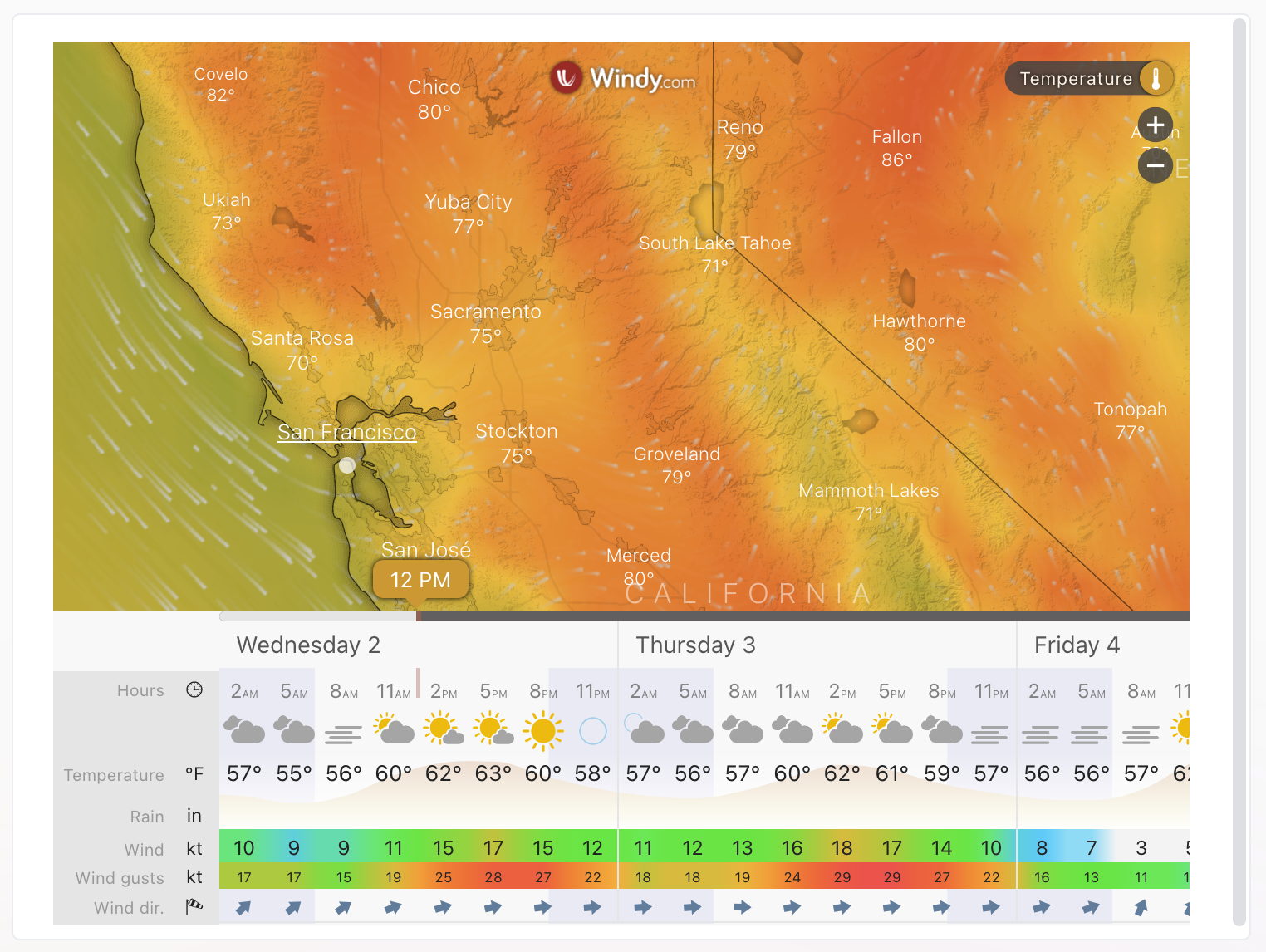
YouTube
YouTube
Code:Result: